Every garden has that one shadowy spot where nothing seems to thrive. A dim corner beneath a tree canopy, a north-facing fence line, or the shady side of a garage where sunlight barely reaches. Most plants sulk in such conditions, but a select group of vigorous vines actually prefer them. These are the fragrant climbers for shade, and they can transform a forgotten space into the most evocative part of your yard in a single growing season.
Why Fragrant Climbers for Shade Deserve a Spot in Your Garden
Little six-packs of annual starts add immediate color to a sunny bed. But creating a truly immersive landscape requires more than a splash of annual color. You need height, texture, and fragrance. A slow-growing magnolia is a lovely long-term investment for spacious yards where time is not pressing. But many of us have problem areas in the shade that need help right now. Think of a drab fence, a stained wall, or a corner with prying eyes from next door.
Luckily, there is a faster way to cultivate gorgeous living screens of fragrant color in shady spots. Introducing fast-growing fragrant climbers for shade gives you quick coverage, vertical interest, and a corridor of scent that changes the entire mood of your outdoor space. These evergreen and deciduous vines fill quiet corners with fragrance, create visual decoys for unsightly areas, and form pretty screens that keep neighbors at bay. By selecting varieties that tolerate the cooler, filtered light of a north-facing wall or a dappled corner, you turn a forgotten space into the most memorable part of your garden.
Planting in May gives these vigorous climbers time to establish their root systems while soil conditions remain agreeable. Get these vines in the ground now, and you will soon enjoy a living tapestry of scent that adds a whole new dimension to shade gardening. These fast-growing shade lovers are uniquely adapted to reach for light, and they manage an impressive vertical stretch in a single season. They excel at concealing rusted chain-link fences or stained walls. Because many are a mix of hardy perennials and vigorous annuals, they cater to a range of USDA hardiness zones. Whether you need evergreen privacy or a lush summer screen that disappears in winter, these plants deliver.
How to Plant Fragrant Climbers for Shade Successfully
Before planting these fast-growing flowers, enrich your site with organic compost to ensure a moisture-retentive base. Most of these climbing plants are heavy drinkers because they support so much foliage. If you are planting near a house wall, remember the rain shadow — that dry patch of earth against the bricks. Planting vines 12 to 18 inches away from the base of the wall ensures they get the hydration and airflow they need to stay lush and mildew-free.
Sort out any supports while your plants are young, when there is less risk of damaging roots. Test your soil before planting. If your soil is very clay-based, amend it with a little coarse sand or perlite to ensure the site drains well. Good drainage prevents root rot, which is a common killer of vines in heavy soils. Set up trellises, arbors, or wire systems early. Disturbing roots later to add a support structure can set your plants back by a full season.
7 Fragrant Climbers That Fill a Shady Corner Fast
Here are seven exceptional vines that thrive in low light, grow rapidly, and fill the air with unforgettable fragrance.
1. Poet’s Jasmine (Jasminum officinale)
Poet’s jasmine grows fast and lights up your garden with fragrant white blooms. It attracts bees, butterflies, and hummingbirds. This vine quickly reaches up to 40 feet tall with a spread of 15 feet, making it a champion for high-impact coverage. The flowers appear in star-shaped clusters that offer a classic, romantic jasmine scent. The fragrance is most potent at dusk and through the night, which makes this plant perfect for a moonlight garden near a bedroom window or patio. It is known as a vespertine bloomer and is popular with night-flying pollinators.
The plant has a second calling card as well. The gorgeous flowers are edible. You can use them in teas, desserts, and even salads for a delicate floral note. In hot climates, zones 7 through 10, poet’s jasmine thrives in partial shade. Provide sturdy support from day one because the twining stems need something to grip. Prune after flowering to prevent tangling and keep the plant manageable. Do not let the soil dry out completely. Key varieties to look for include ‘Fiona Sunrise’, which offers chartreuse foliage, and ‘Clotted Cream’, which has buttery cream-colored blooms. Pair poet’s jasmine with dark-leaved heuchera for a striking contrast.
2. Common Honeysuckle (Lonicera periclymenum)
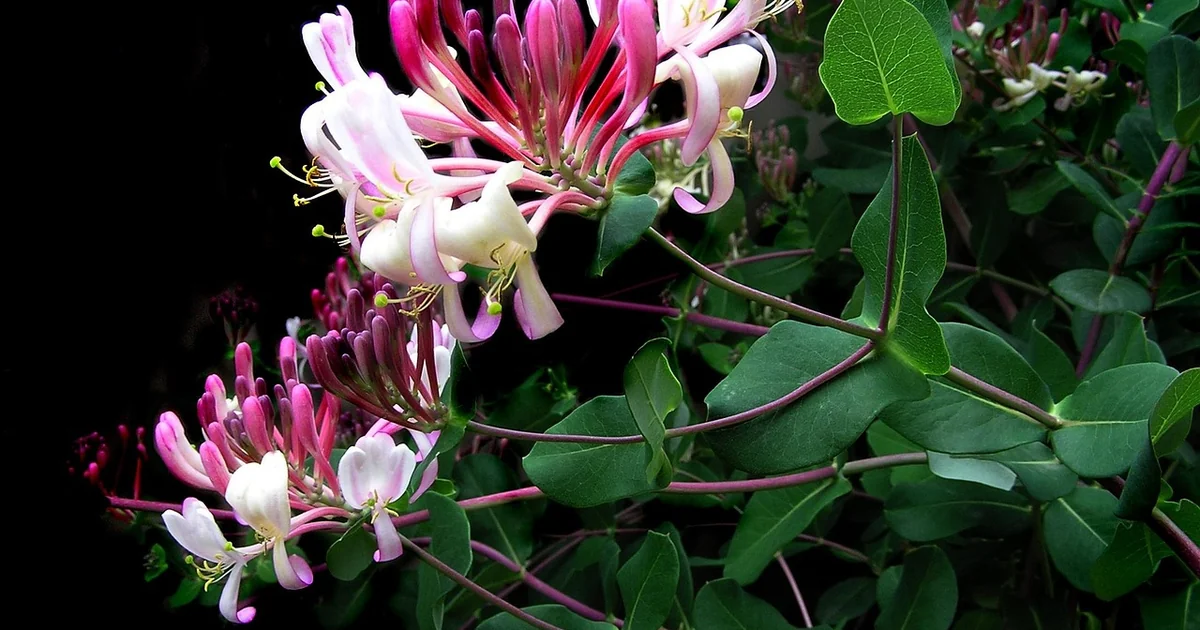
Common honeysuckle is a flowering vine with a heady, sweet fragrance that carries across the garden. Its tubular blooms appear in shades of cream, pink, and yellow, and they attract hummingbirds and bees throughout the summer. This vine grows vigorously, reaching 15 to 20 feet in a single season under the right conditions. It prefers partial shade, especially in warmer climates where afternoon sun can scorch its leaves.
The scent of common honeysuckle is most noticeable in the evening, similar to poet’s jasmine. Plant it near a seating area or an open window to enjoy the fragrance as you relax. This vine is a hardy perennial in zones 4 through 9, making it a reliable choice for cooler regions. Prune lightly after the first flush of blooms to encourage a second wave of flowers. Honeysuckle is a heavy feeder, so apply a balanced fertilizer in early spring and again in midsummer. Watch for aphids, which sometimes cluster on new growth. A strong spray of water from the hose usually dislodges them without the need for chemicals.
3. Climbing Hydrangea (Hydrangea anomala petiolaris)
Climbing hydrangea is a self-clinging vine that scales walls, fences, and tree trunks without needing a trellis. It produces large, lace-cap white flower clusters in late spring and early summer. The blooms have a subtle, honey-like fragrance that becomes more noticeable when the plant is in full flower. This vine is one of the few fragrant climbers for shade that tolerates deep shade, making it ideal for north-facing walls or dark corners under mature trees.
Climbing hydrangea grows more slowly in its first year as it establishes roots, but once settled, it accelerates to cover large areas. It can reach 30 to 50 feet at maturity. The exfoliating bark adds winter interest when the leaves drop. This plant prefers moist, well-drained soil rich in organic matter. Mulch heavily around the base to keep the roots cool and damp. Climbing hydrangea is hardy in zones 4 through 8. It does not need regular pruning, but you can trim wayward stems in late winter to keep the shape tidy.
You may also enjoy reading: Cherry’s Spring Prelude Tour: 5 Butchart Gardens Wonders.
4. Chocolate Vine (Akebia quinata)
Chocolate vine earns its name from the spicy, chocolate-scented flowers that appear in early spring. The blooms are small, reddish-purple, and shaped like bells. They hang in clusters and emit a fragrance that reminds many gardeners of vanilla and cocoa mixed together. This vine grows with astonishing speed, reaching 20 to 30 feet in a single season. It is a semi-evergreen in mild climates and fully deciduous in colder zones.
Chocolate vine thrives in partial shade but will also grow in full sun if the roots stay cool. It produces edible, sausage-shaped purple fruits in late summer if a second plant is nearby for cross-pollination. The fruits have a mild, sweet flavor that some describe as a cross between banana and melon. This vine is hardy in zones 4 through 9. It can become invasive in some regions, so check local guidelines before planting. Prune hard after flowering to keep it in bounds. The foliage is a handsome blue-green that provides a lush backdrop for other shade plants like ferns and hostas.
5. Sweet Autumn Clematis (Clematis terniflora)
Sweet autumn clematis bursts into bloom in late summer when many other vines have finished flowering. The small, white, star-shaped flowers cover the plant in a cloud of petals, and the fragrance is intensely sweet, reminiscent of vanilla and almond. This vine grows rapidly, reaching 15 to 20 feet in a single season. It is a vigorous perennial that dies back to the ground in winter and regrows each spring.
Sweet autumn clematis prefers partial shade, especially in hot climates where the roots need to stay cool. Plant it where the foliage can reach sunlight but the root zone remains shaded. A layer of mulch or a low-growing ground cover around the base helps keep the roots comfortable. This vine is hardy in zones 4 through 9. Prune it back to about 12 inches in late winter or early spring before new growth begins. The flowers attract bees, butterflies, and other pollinators. Be aware that this plant can self-seed aggressively in some areas, so deadhead the spent blooms if you want to control its spread.
6. Star Jasmine (Trachelospermum jasminoides)
Star jasmine is an evergreen vine with glossy, dark green leaves and clusters of small, white, pinwheel-shaped flowers. The fragrance is rich, sweet, and similar to jasmine, though the plant is not a true jasmine. It blooms profusely in late spring and early summer, with occasional flowers appearing through the rest of the growing season. Star jasmine grows steadily, reaching 15 to 20 feet at maturity. It is a self-clinging vine that attaches to walls and trellises with aerial roots.
This vine tolerates partial shade well, especially in warmer climates where full sun can scorch the leaves. In zones 8 through 10, star jasmine is evergreen and provides year-round coverage. In cooler zones, it can be grown in a container and moved indoors for winter. The fragrance is strongest on warm evenings, making it a wonderful choice near patios, decks, or bedroom windows. Star jasmine is low-maintenance. Water regularly during dry spells and fertilize with a balanced slow-release fertilizer in spring. Prune after flowering to shape the plant and encourage bushier growth.
7. Climbing Rose ‘Zephirine Drouhin’
‘Zephirine Drouhin’ is a climbing rose with a powerful, old-rose fragrance that fills the air around it. The flowers are a rich, deep pink and bloom repeatedly from late spring through fall. This rose is thornless, which makes it a pleasure to prune and train. It grows 10 to 15 feet tall and spreads about 6 feet wide. Unlike many roses that demand full sun, ‘Zephirine Drouhin’ performs well in partial shade, especially in warmer climates where afternoon shade prevents the flowers from fading.
This rose is hardy in zones 5 through 9. It prefers rich, well-drained soil and regular watering. Apply a rose-specific fertilizer in early spring and again after the first flush of blooms. Prune in late winter or early spring, removing dead or weak canes and cutting back lateral shoots to two or three buds. Train the main canes horizontally to encourage more flower production. ‘Zephirine Drouhin’ is disease-resistant compared to many older roses, but it can still develop black spot in humid conditions. Space the canes for good airflow and avoid overhead watering to keep the foliage dry. Pair this rose with purple-flowered clematis or silver-leaved artemisia for a stunning combination.
These seven vines prove that shade does not have to be a limitation. With the right selection of fragrant climbers for shade, you can turn a dim, overlooked corner into a lush, scented retreat that you will look forward to visiting every evening. Plant them in May, give them sturdy support and consistent moisture, and watch them transform your garden in a single season.