What Defines a Modern Pool Garden?
Freeform pool shapes paired with textured stonework and waterfalls define midcentury modern design. Tower Design applied this language to a pool that blends into its setting through a cascading waterfall and organic stone edge. The shape sidesteps rigid geometry, creating a landscape-driven silhouette that feels both retro and deliberate. That same balance of structure and flow runs through many modern pool gardens.
OJB Landscape Architects pushed the modern vocabulary into arid terrain with a desert gathering space. An infinity pool looks onto a fire pit and xeriscape planting, where Mexican fence posts, barrel cacti, and succulents replace turf. The palette is restrained, but the effect is expansive. Hard lines and rugged textures give the space a quiet confidence that works in direct sunlight and long shadows.
Color and personality enter the modern category through Daniela Gottschalk of Tinzeltown, who designed a pop-art pool with graphic tile accents, yellow and blue lounge chairs, and striped umbrellas. The controlled composition means every piece is chosen, not accumulated. The furniture reads as sculpture against the clean white decking, and the pool becomes a stage for saturated color. This creates a visual contrast that energizes the space.
Architecture often anchors a modern pool garden. Richardson & Associates Landscape Architecture designed a poolhouse with a fireplace, TV, and lounge seating, pulling the program outdoors. MMB Studio took a similar approach by designing an open-air living space for a desert poolside retreat, pairing modern architecture with natural grasses. The result is a room without walls, where the pool anchors a social core.
For urban sites, Bell Design, Inc carved a city townhouse pool from a tight footprint. Robert Bell of Bell Design, Inc selected natural cleft full-color-range bluestone paving, fieldstone walls, and a dark blue-gray pool interior. The dark water absorbs sunlight and quiets the space. In a Bay Harbor, Michigan house, Hilary Harrington used travertine paving on a pool patio and added a negative edge spa and baja shelf, creating a seamless horizon that pulls the eye across the water.
Modern pool gardens rely on bold geometry, material contrast, and integrated architecture. They trade floral abundance for sculptural clarity, and the best examples feel as tailored as the rooms inside the house. These designs prioritize structure over ornament. The result is a pool area that feels like an extension of the home’s architecture, with each project tailored to its site and climate.
What Makes a Tropical Pool Garden?
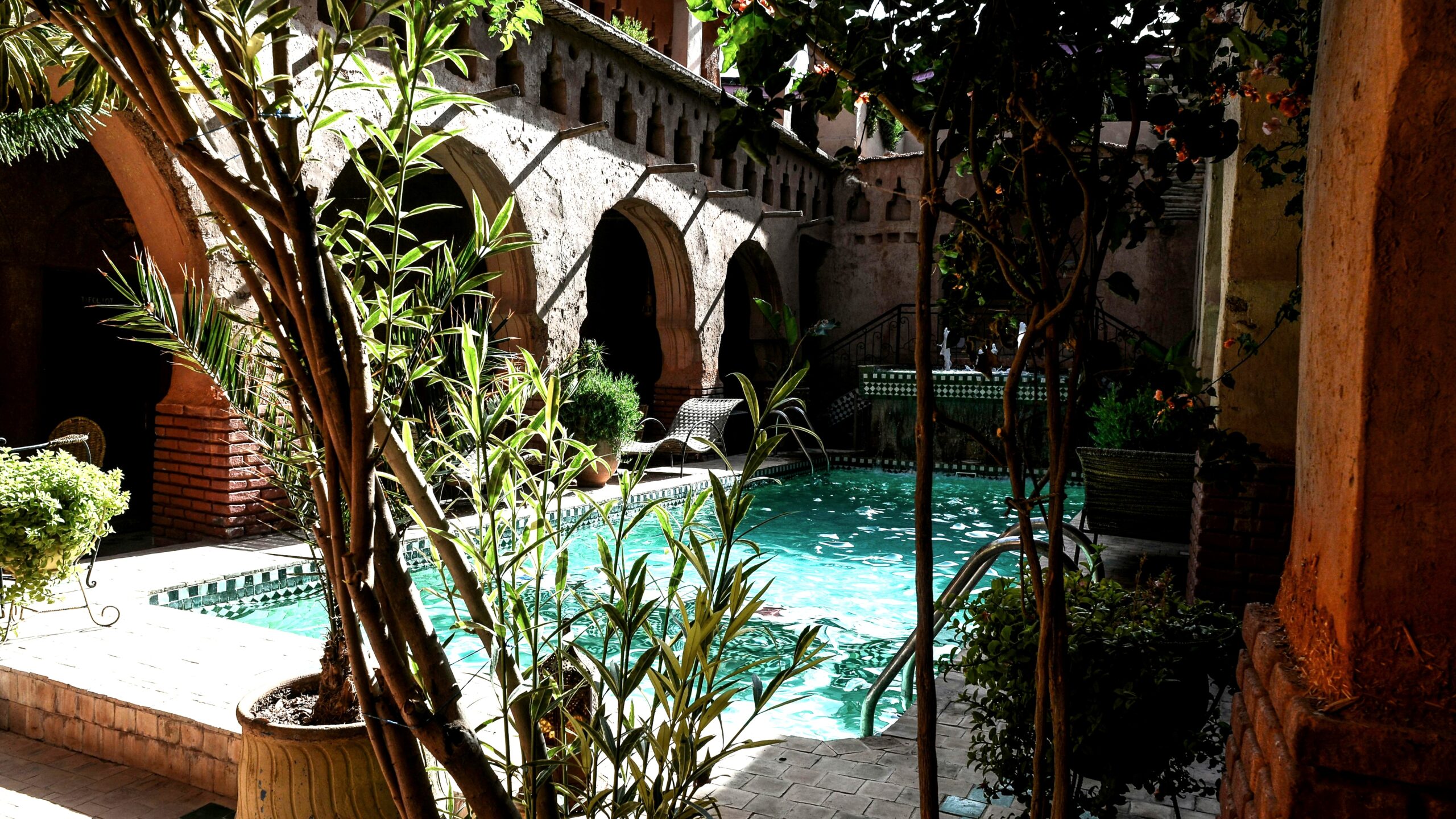
From the clean geometry of modern designs, we move to tropical styles that embrace organic abundance. A tropical pool garden builds enclosure and drama through planting, not through hardscape. One poolscape design layers hard elements—a stucco outdoor fireplace with built-in seating and decorative lanterns—with palms, flaming firesticks, soft grasses, and manicured hedges. The mix creates a dense, protective edge that filters sun and frames the water.
MMB Studio installed a Palm Beach poolscape with white architecture, manicured greenery, and black-and-white striped accents. The planting is disciplined—not overgrown—but the palms and clipped hedges read instantly as tropical. The palette stays tight, so the texture feels rich rather than chaotic. The black-and-white striped accents reinforce the tropical aesthetic without overwhelming the landscape.
In Phoenix, a poolscape leans on tall palms to frame panoramic views, with natural rock accents anchoring the planting beds. The palms stand like columns, drawing the eye upward and outward. Here, the tropical feel comes from verticality and shadow rather than broadleaf overgrowth. The planting zones are narrow but strategic, controlling sightlines and providing filtered light.
To create a tropical pool garden, start with structure: a strong evergreen backbone of palms or sculptural succulents, then layer in softer grasses and accent plants with warm-season color. Manicured hedges at the perimeter keep the look intentional. Water features—a sheer descent or a raised spa spillway—add the sound of moving water, which amplifies the vacation atmosphere. Keep the material palette consistent so the planting does the heavy lifting.
How Do Rustic Pool Gardens Use Natural Stone?
While tropical pools go lush, rustic pools lean into natural materials and site sensitivity. A sloped lot can become an asset with the right engineering. Campbell Landscape Architecture designed terraces and retaining walls for a poolscape that steps down the grade, topped with a raised cascading hot tub. Annie-Laurie Grabiel ensured the stonework reads as a natural extension of the hill, not a barrier against it.
On Lake Charlevoix, Michigan, Drost Landscape designed a curved pool with a patio of irregular bluestone. Hilary Harrington worked on the project and included a baja shelf with bubblers, so the waterline meets the stone without a hard edge. A separate Northern Michigan pool design ties infinity edges into a fieldstone boulder wall, with bluestone on the patio and baja shelf. Here, the rockwork looks gathered from the shoreline, not cut from a quarry.
C&C Partners took a sunk-en approach for a pool garden, building retaining walls and built-in benches dressed with climbing ivy. The ivy softens the masonry and introduces seasonal change. Robert Bell of Bell Design, Inc renovated a West Palm Beach courtyard pool using creamy striated limestone coping and vintage Chicago pavers, replacing an expanse of terrace paving with stepping stone pathways and lawn. The rhythm of stone to grass slows the pace and gives the garden a lived-in look.
Rustic pool gardens work best when the materials look older than the house. Fieldstone, irregular bluestone, weathered limestone, and creeping ground covers make the pool feel settled. The shapes stay curved or irregular, and the planting is calibrated to frame views without blocking the flow. At the opposite end of the spectrum, minimalist pool gardens prove that less really can be more.
What Is a Minimalist Pool Garden?
After exploring rustic materiality, minimalist design strips everything back to purpose and form. A minimalist pool garden uses negative space, precise geometry, and a narrow material palette. Re: Design Architects designed a symmetrical pool layout for a beach house in Southold, New York, raised on an elevated deck. The symmetry squares the pool against the horizon, and the deck creates a platform that separates the water from the surrounding sand and scrub.
Bambi A’Lynn Interior Design outfitted a pool landscape with neutral-toned hardscaping and manicured greenery, avoiding flower borders or ornamental accessories. The plants are clipped and spaced, and the stonework uses a single tone that recedes visually. This simplicity allows the pool to become the object in the room. The result is a serene environment where the water and sky are the primary features.
Blueberry Jones Design took a bolder route with a dark-toned raised geometric pool. A built-in spa and baja shelf are integrated without breaking the clean lines. The deep color of the pool shell absorbs light, so the water surface mirrors the sky. Studio BV added an artistic layer with a geometric art installation set among desert plants—sharp against the organic forms, but restrained in number of elements.
For pool owners tired of debris, Richardson & Associates Landscape Architecture used natural stone pavers to eliminate grass clippings from reaching the water, with Joseph Richardson noting that even a small buffer of stone around the pool edge can cut maintenance and keep the sightline crisp. To achieve a minimalist pool landscape, start with a strong geometric boundary—a rectangular or square pool, a flush coping, and a single paving material. Limit plants to structural species used in repetition, such as a row of agaves, a grid of boxwood, or a stand of ornamental grasses. Omit fire features and complex water effects; let the pool’s stillness and the sky do the work.
What Plants Are Best for Poolside Screening?
Designers use ilex, boxwood, and hydrangea to screen exposed corner lots. Richardson & Associates Landscape Architecture planted these on two sides of a corner property to create a dense, year-round boundary. Joseph Richardson also incorporated ornamental grasses at the perimeter, with one palette including nearly 50 species, many of them native. That mix of woody screening and grass textures provides privacy without a fence, and the variety ensures continuous seasonal interest.
For poolside planting, prioritize species that drop minimal litter, such as broadleaf evergreens like ilex and boxwood that hold their foliage and tolerate shearing. Hydrangea adds summer volume without the constant shedding of large leaves. Ornamental grasses catch the light and move in the breeze, but plant them well back from the water’s edge to avoid blade drop. Native grasses can reduce irrigation demands and support local ecology while softening the hardscape edge.
Avoid trees with invasive roots near the pool shell, and choose paving that lets water drain away from planting beds. A raised planter or a strip of gravel between the lawn and the pool coping prevents clippings and mulch from washing in. Thoughtful planting choices make a pool garden feel enclosed without turning maintenance into a chore. This approach ensures the pool area remains clean and inviting season after season.
Conclusion
Each pool garden style starts with the same goal: a space that feels connected, intentional, and liveable, whether through modern geometry, tropical lushness, rustic stonework, or minimalist precision. Tropical pools bank on lush planting to wrap the water. Rustic landscapes use stone and earth to tie the pool to its site. Minimalist gardens pare back every element until only the essential remains.
Across all four, the best projects come from designers who read the site first—its slope, view, light, and wind—and then apply a clear material and planting language. Practical moves like thoughtful screening and low-debris plant choices keep the retreat working season after season. The right style isn’t the loudest one; it’s the one that fits the way you live outdoors.
FAQ
Q: What is the difference between a modern and a minimalist pool garden?
A: Modern pool gardens often feature bold geometric shapes, statement materials, and integrated architecture, while minimalist pools strip away ornament to focus on clean lines, neutral palettes, and a sense of calm.
Q: Which plants are best for screening a pool area?
A: Richardson & Associates Landscape Architecture recommends ilex, boxwood, and hydrangea for screening. Ornamental grasses also work well, with some designs using nearly 50 species, many native.
Q: Can a pool garden work on a sloped lot?
A: Yes. Campbell Landscape Architecture designed terraces and retaining walls for a sloped lot poolscape, incorporating a raised cascading hot tub. Stepped designs turn challenging terrain into a feature.